Soda Can
[flowplayer src=’fu_sodacan.mov’ width=480 height=270 splash=’fu_sodacan.jpg’]
Made a small Fusion comp that relights a rendering of an FBX mesh using a normal pass which is also generated inside Fusion (requires verison 6.1+). Based on an idea from this youtube video. The mesh is a free one from turbosquid.com.
Weiteres Shanghai-Blog
Ein ehemaliger Arbeitskollege von mir ist ebenfalls dem Ruf des großen Abenteuers gefolgt und hat bei Pixomondo Shanghai angeheuert. Sein Blog mit vielen Fotos findet sich unter lazlogonzalez.blogspot.com.
Contrast
I’ve always had a hate/hate relationship with the “contrast” slider – no matter which software. It would always clip the shadows, or worse, create negative values if used on floating point data (less of an issue in Photoshop but easily observable in Fusion). It looked ugly and I’ve spent a lot of redoing other people’s grading nodes because the color values were broken all over the place.
If you don’t know it already, here’s what the contrast slider usually does:
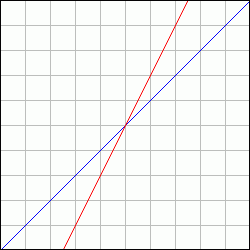
contrast as found in most image editing software
If you color-correct in sRGB (yuck) the slider really does change the picture’s contrast. But like I said, it clips shadow details pretty quickly. Which translates to “instantaneous” in linear (non-gamma-corrected) space where color values are tiny. The better way to increase contrast was an S-shaped curve tool (recently, Photoshop has finally improved its contrast algorithm and labeled the formula it used before as “legacy”).
Nuke also has a contrast slider in its color correction node. First I avoided it like the plague until I tried it on a test gradient to figure out what it does. Lo and behold, it’s actually usable since its formula has been re-invented for linear floating point pipelines. It is actually a gamma correction but instead of “pivoting” around a value of 1.0 it is anchored on 0.18 – neutral gray in linear space:
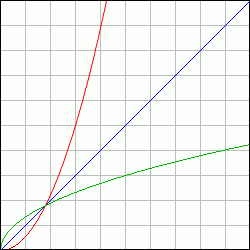
contrast as implemented in Nuke (on a scale from 0.0 to 1.0)
The formula is easy to implement: pow(color / 0.18, contrast_value) * 0.18
Of course it needs a failsafe when contrast_value is zero, but this is obviously a constant value of 0.18.
I have built this formula into a Fuse for Fusion along with Nuke’s other color correction sliders. This makes the tool useful to copy color corrections made in a Nuke script to Fusion. It could have been a macro, but the Fuse API allowed me to play around with the GUI and make Nuke users feel even more at home – myself included.
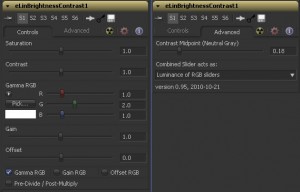
Download and more info at Vfxpedia.
Die Bahn kommt
Vielleicht sollte man bei der Bahn die Milliarden für das Unsinnsprojekt Stuttgart21 sinnvoller verwenden, nämlich um “technische Defekte” im Bordbistro zu vermeiden, damit man als Fahrgast in einem Morgenzug um halb 7 ein fucking Frühstück essen kann. Just saying….
Welches Schweinderl hätten’s denn gern?
Letztens wurde mir beim Onlinebanking folgendes Angebot unterbreitet:

Jetzt geht es mir gar nicht darum, dass es vor wenigen Jahren – bevor die Zentralbanken unseren Geldkreislauf mit billigem Money fluten mussten – noch mindestens doppelt so viel Zinsen gab… Es geht mir um die Infografik. Das Schweinderl wächst also kräftig vor sich hin, trotz Diätzinsen von 2% p.a. und einer nur mittelmäßig engagierten weiblichen Hauptrolle. Messen wir doch mal nach:

Aha. Von 85 auf 103 Pixel. Das sind nach Adam Riese und eindimensional gerechnet 21% Zuwachs! Holla die Waldfee, sowas kann in überschaubaren Zeiträumen nur Ackermann persönlich. Denn bei zwei Prozent und unter Berücksichtigung von Zinseszinsen benötigt unser normalsterbliches Kapital fast genau 10 Jahre für diesen Zuwachs.
Bedenkt man aber, dass das Volumen sich kubisch vergrößert, so hätten wir schon einen Zuwachs von 78%. Bei 2% p.a. bräuchte das Geld also fast 30 Jahre (29 um genau zu sein), um mit dem Schweinderl die erste Stufe mitzuhalten.
Wir Sind Die Nacht
 Seit Donnerstag läuft Wir Sind Die Nacht in den Kinos. Ein deutscher Vampirfilm, der – wie soll es heutzutage auch anders sein – in Berlin spielt, und trotz aktuellem Vampirboom glücklicherweise nicht versucht, Twilight zu kopieren. Den Kritikern gefällt’s.
Ich hatte die Ehre, zu den Visual Effects beizutragen.
